Visualizzazione post con etichetta 1700. Mostra tutti i post

giovedì 2 gennaio 2025

AWI: Hassian Rgt Von Raal

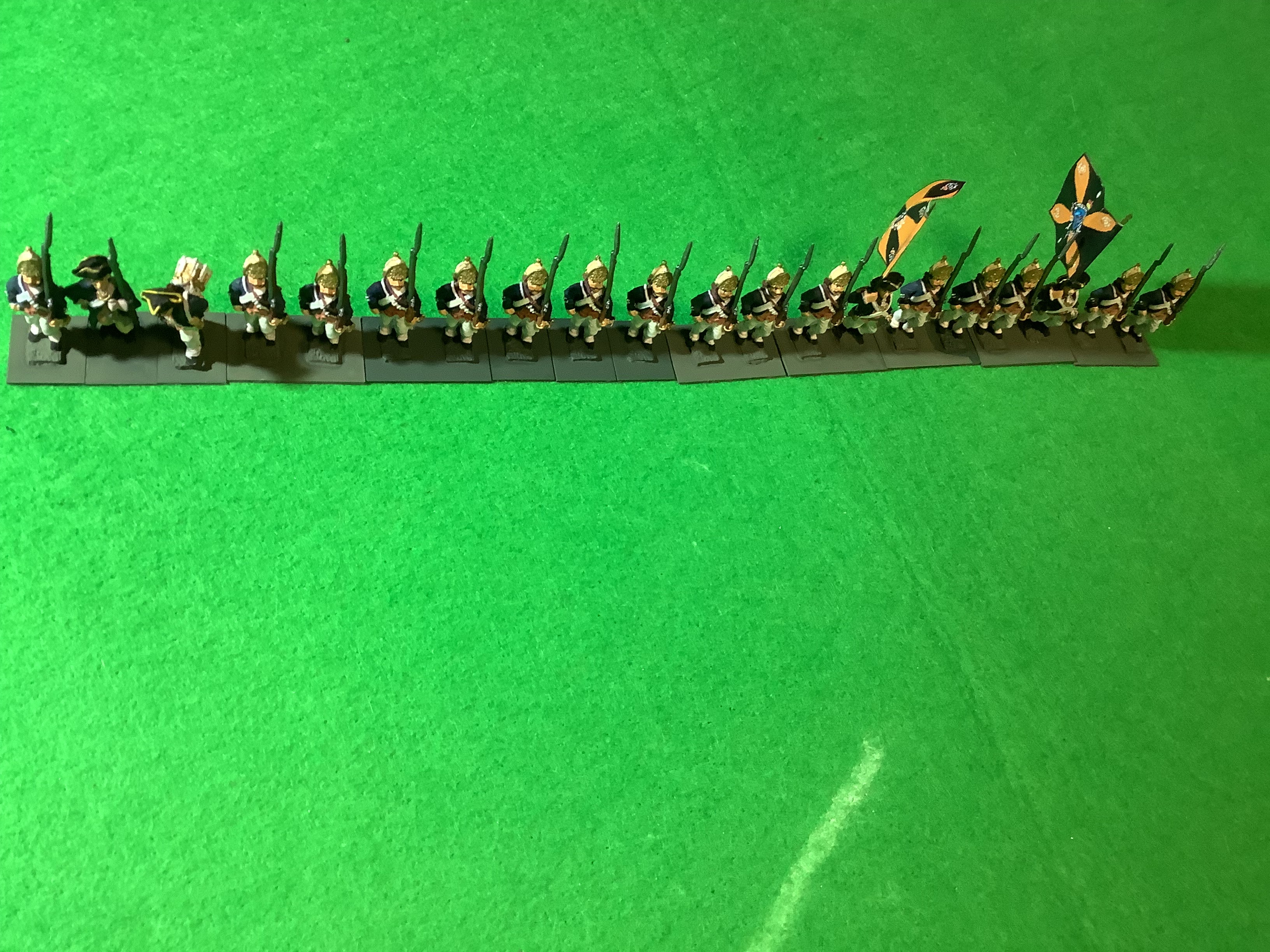
Finalmente sono riuscito a completare il mio reggimento di fanteria hassiano! Mancavano sette figure all’appello per completare i ranghi, arrivate finalmente a settembre con il mio ultimo ordine alla Gripping Beast. Ora sono presenti 4 rgt di formazione composti dai granatieri di diverse unità, 7 battaglioni di moschettieri o fucilieri, uno per reggimento, un battaglione di Jager. Chiusi nelle scatole dei pezzi da dipingere ho ancora un’unità di Jager e un’unità di dragoni del Brunswick a piedi. 


domenica 27 ottobre 2024

NapFlag: napoleonic German States

Baden 1806-1815

Baden joined the Confederation of the Rhine in 1806 and immediately began to re-organise its army on the French pattern. By 1809 the army consisted of the Gardes du Corps squadron, a regiment of light dragoons, one of hussars, a corps of artillery with one horse and two foot companies. A Lieb Garde grenadier battalion, a jager battalion and four regiments of line infantry, the first of these being the Leib regiment. In 1808 the 4th regiment was re-organised for service in Spain and the 1st battalion of that regiment was exchanged for the 2nd battalion of the 3rd regiment. It is most likely that the new 3rd and 4th regiments retained the flags of the old regiments of the same number. The infantry Regiments consisted of two battalions, each of which was issued with a flag, the 1st battalion carried the Leibfahne, the 2nd the Regimentersfahne. The Liebfahnen were withdrawn in 1808, except possibly from the 2nd regiment. The flags were carried on plain wooden staves with brass finials. I have been unable to ascertain the dimensions of these flags and standards and so have used 130 x 130 cm for the infantry flags and roughly 100cm square for the cavalry standardswhich looks about right. Sources conflict as to the exact design of flag carried by the Leib or 1st infantry regiment so I have included both possibilities here - let the wargamer decide! The Gardes du Corps squadron had a vexillum standard mounted on a white horizontal bar and stave, the finial (in the form of a griffon) and chains were silver. The Hussar and Light Dragoon regiments each had a single standard which were carried on plain wooden staves with brass spear shaped finials.
Divider
The Infantry Flags from top to bottom:
1st or Leib regiment pattern one
1st or Lieb regiment pattern two
2nd regiment
3rd regiment
4th regiment
Liebfahne on left, Regimenterfahne on right


The Cavalry Standards from top to bottom:
The Garde du Corps vexillum
Note: The colouring used here is largely conjectural
The hussar regiment
The light dragoon regiment


Bavarian Infantry 1786 - 1815

The flags carried by the Bavarian regiments underwent many changes during the Napoleonic Wars. At any one time the flags carried by the army included examples issued in the previous century, more recent issues which had been altered as the status of Bavaria changed, or completely new issues. Details of which regiment carried which particular pattern and at what time are unknown. However it is certain that as late as 1812 the regiments carried flags of all the patterns and variants presented here.
At the turn of the 18th century Bavarian infantry regiments carried one Leibfahne and one Ordinarfahne, the Leibfahne was carried by the 1st Battalion. In October 1801 this was changed to two Leib- and two Ordinarfahnen. In December 1803 the scale of issue was changed to one Leib- and three Ordinarfahnen, and in March 1804 to one Leib- and one Ordinarfahne, carried by the 1st and 2nd field battalions respectively. Two flags per regiment remained the norm for the remainder of the Napoleonic period.
All flags issued before 1813 were carried on staves with a light blue velvet covering, the flags issued in 1813 had staves covered in black leather. All staves were topped by a gilt spear-shaped finial which was either pierced or engraved with the cypher of the elector or king. The ferrules were also gilt. Gold fringed blue and white cravats 1.06 metres long by 18cm wide were tied beneath the finials. These cravats were usually plain, however some richly embroidered examples were presented by colonels and senior officers to some regiments.

The Flags from top to bottom:
First Row: 1786 Patterns. Note - the coat of arms is based on an incomplete written description and so represents my best guess!
If anyone out there knows better.....
Second Row: Patterns issued sometime between 1800 and 1803.
Third Row: 1803 Patterns - The plain Ordinarfahne was also issued to some regiments in 1813.
Fourth Row: 1806 Patterns.
Fifth Row: 1808 Patterns.
Ordinarfahnen on left, Leibfahnen on right.


Variations on a Theme
Divider
The flags issued during the period 1800 to 1806 usually had a triple row of lozengy for the border as shown above. However the border of some flags was increased to four rows whilst on some others it was reduced to two rows. The plain pattern flag issued in 1803 and re-issued in 1813 could have either vertical rows of lozengy as shown above or horizontal rows as below. I have included these variants here so that the user can cut and paste to produce which ever variation they require - let the wargamer decide.


Brunswick Infantry 1815


I have been unable to discover what flags, if any, where carried by the Brunswick troops prior to 1814. During the Waterloo campaign in 1815, the three Light battalions, the Leib battalion, the Avantgarde battalion and the cavalry units were not issued with standards. The three Line battalions carried two flags each, The Herzogfahne (Duke's flag) and the Bataillonfahne (Regimental flag), the patterns for these varied from battalion to battalion. All the flags were carried on a three metre long staff topped by a gilt spear-shaped finial bearing the ducal monogram. Mixed yellow and silver cords and tassels were attached immediately below the finial. Dimensions for the flags of the 1st and 2nd battalions were 140cm square, whilst those of the 3rd battalion were 144cm X 150cm for the Bataillonfahne and 142cm square for the Herzogfahne. I have drawn all the flags at a scale 150cm square so those requiring strict accuracy should adjust for this when resizing.
divider
Below: Top to Bottom, 1st, 2nd and 3rd Line Battalions
Herzogfahne on left, Bataillonfahne on right


The Danish Auxiliary corps 1813


A treaty of alliance between Denmark and France was signed on the 10th July 1813. The treaty dictated that Denmark would supply a force known as the "the Danish Auxiliary corps" which, together with three smaller French divisions made up the newly created French XIII army-corps commanded by Marshal Davout. The Danish contingent consisted of the following:

The Queens Life regiment of foot 1st Battalion
Oldenburg Infantry regiment 1st, 2nd and 4th Battalions
Schleswig Infantry regiment 1st and 2nd Battalions
Holstein Infantry regiment 3rd and 4th Battalions
3rd Jutland Infantry regiment 1st Battalion
Fyenen Infantry regiment 1st and 2nd Battalions
Schleswig Jaeger corps 2nd Battalion
Holstein Sharpshooter corps 1st and 2nd Battalions
3rd company of Slesvigske Jaeger corps
The Light company of the Queens Life regiment of Foot 2nd Battalion
The Light company of the Oldenburg Infantry regiment 3rd Battalion
The Hussar Regiment 2nd and 6th Squadrons
Holstein Cavalry regiment 4 squadrons
2nd Fyenen light dragoons regiment 4 squadrons
Battery Gerstenberg (a 6-pounder battery of foot. 10 guns)
Battery Koye (a 6-pounder battery of foot. 10 guns)
Battery Friis (a 6-pounder battery of foot. 10 guns)
Battery Gönner (a 3-pounder mounted battery. 10 guns)

In all about 10,200 men.

In 1813 the Danish infantry regiments consisted of four battalions each of which seems to have been issued with at least one and possibly as many as four pairs of flags (possibly one pair per company), a pair consisted of a king's colour and a regimental colour. It seems that the light infantry regiments were not issued with flags. The cavalry regiments consisted of four squadrons each of which carried an identical squadron standard, the cavalry do not appear to have been issued with king's colours.

Infantry Flags from top to bottom:

The Queens Life regiment of foot
Oldenburg Infantry regiment
Schleswig Infantry regiment
Holstein Infantry Regiment
3rd Jutland Infantry Regiment
Fyenen Infantry regiment

Regimental colour on left, Kings colour on right


Cossacks - Clann Tara Miniatures

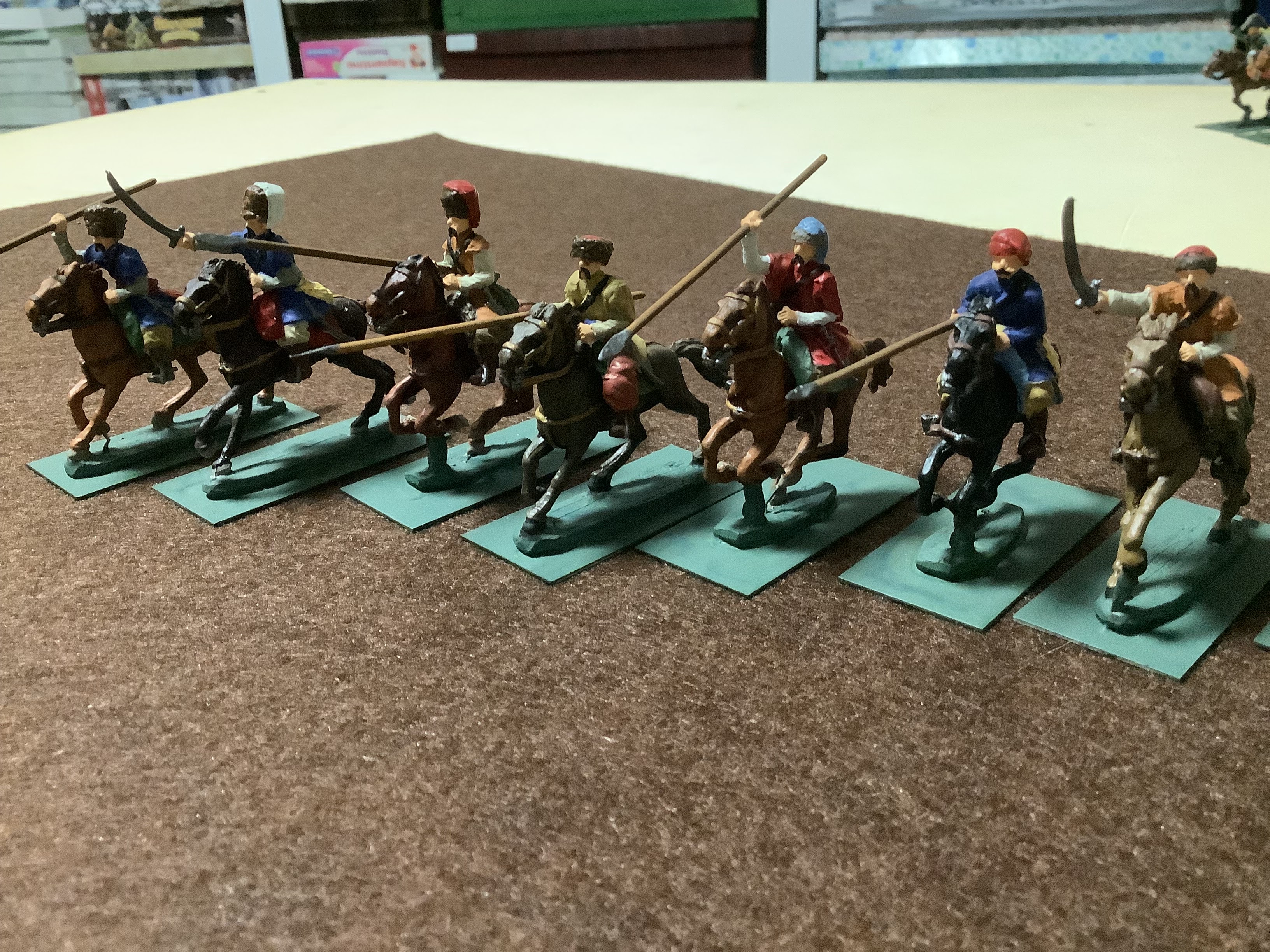
Mi ero ripromesso di non comprare altre cavalleria napoleonica per i russi.  Quindi ho comperato i cosacchi, ma si sa che sono pieno di controsensi. Ma ad essere sincero ho comprato anche gli ulani ad essere sincero, ma questo è un altro discorso. 

Questi pezzi li ho comprati dalla Crann Tara Miniatures, pentendomene non poco. La qualità è discreta e per il prezzo di listino di allora più che soddisfacenti. Il problema che ho incontrato è stato il passaggio di proprietà dalla vecchia gestione al nuovo titolare, un tipo assai poco piacevole. Che poi sarebbe anche il nuovo (già da qualche anno) proprietario della Minifig Miniatures. Quando ordinai i Minifig non li spedì e dovetti ricorrere a PayPal per riavere i soldi; prima mi disse che aveva spedito, poi che si era perso il pacco, infine che c’era stato un problema. Di queste figure ne ha spedite solo 10, anzichè 12, rimborsando la differenza. Però non aveva spedito i cavalli, che ha inviato in un secondo momento, facendomi non poche difficoltà. 

Alla fine eccoli finiti. Come figure sono piuttosto carine, anche se un pò superate per incisione e dettaglio, ma essendo dei cosacchi questo particolare non ne pregiudica l’effetto sul tavolo. Poi potrei integrarli con qualche Perry Miniatures cosi da poterne avere una ventina. 


domenica 13 ottobre 2024

Warflag: 7YW reicharmee

Flags by Warflag 


Hohenzollern Cuirassiers


 Baden Baden

Leibfahne
Regimentsfahne


Baden - Durlach
Leibfahne
Regimentsfahne


Franconia:
Leibfahne
Reg't no.1 Regimentsfahne
Reg't no.2 Regimentsfahne
Reg't no.3 Regimentsfahne


Hesse-Darmstadt:
Leibfahne
Regimentsfahne


Palatinate Regiments:
Leibfahne
Regimentsfahne


I. R. Elverfeldt:
Leibfahne
Regimentsfahne


More info on fantastic Kronoskraf Project:


Leibregiment and Reg't Wildenstein:
Leibfahne
Regimentsfahne


More info on fantastic Kronoskraf Project:

Wurtemburg
Leibfahne
Regimentsfahne


Wurtzburg (speculative)
Leibfahne
Regimentsfahne

Speculative Reichsarmee flags for the Regiments Mainz and Würzburg.
The flags are based on the infantry uniform colour and the arms of the respective city (Mainz has a white wagon wheel; Würzburg the more complex device shown).


I. R. Kurtrier
Leibfahne
Regimentsfahne


venerdì 11 ottobre 2024

Napflag: others nations, USA Netherlands, etc

Flags by NapFlag
The Netherlands

In 1795 the Dutch infantry was organised into half-brigades on the French model. Each half-brigade contained three battalions. Colours of the 1795 pattern were presented to the seven half-brigades between September 1795 and March 1796. I have been unable to ascertain the exact dimensions for the Dutch infantry flags so I have opted for 140cm square for all. The Amsterdam collection contains two battalion flags dated 1799-1806 of a completely different design from the 1795 pattern. It is unknown which units were issued with this pattern, or indeed if they were ever issued. A new 1802 pattern flag was issued to all units begining in May of that year. In 1805 a battalion of Grenadiers of the Guard of the Council was raised, this unit received two standards that were an elaboration of the 1802 line infantry pattern. In 1806 Holland became a Kingdom and at this time the Dutch infantry was organised into nine regiments (1st regiment Guards) and two light regiments all of two battalion strength. New standards measuring 80cm square were presented to the battalions between February and March 1807. On July 9th 1810 Holland was absorbed into France and the regiments were assimilated into the French army, French 1804 pattern flags were issued to all of the ex-Dutch regiments. In 1815 the Regiments of the United Provinces appear to have carried flags of the pattern illustrated below, however there is some evidence that this pattern of flags was not in fact issued until around 1820. The facings of all regular infantry regiments were white, those of the militia were orange and those of the jagers yellow. It is thought that the flags were of the facing colour with a central device and wreath. Some units may also have had the outer border of leaves, although which unit had which pattern is uncertain. The Dutch army museum at Leyden also shows a jager flag as illustrated at bottom left. I have opted for dimensions of 140 x 115cm for these c.1815 designs which 'looks' right.

Batavian Republic Infantry 1795 - 1802


Batavian Repubblic 1799-1806


Batavian Repubblic 1802-1806


Batavian Repubblic 1806-1810


United Provinces Infantry 1815


The Kingdom of Portugal


On 19 May 1806, a royal decree was issued which ordered among other things, the re-organization of the Portuguese army, new styles of uniforms, and new designs for unit flags. Each infantry regiment was issued with two flags, the King's colour in the national colours of red and blue carried by the first battalion and the regimental colour, in the colour of the division to which the regiment belonged, carried by the second battalion. Each cavalry regiment was issued with four standards, one per squadron, the 1st squadron a white standard, the 2nd red, the 3rd yellow and the 4th blue. The infantry regimental flags had cravats in the regimental colours attached immediately below the flag staff heads - see table below. The cavalry regiments cravats were 1st-3rd regiments white, 4th-6th scarlet, 7th-9th yellow and 10th-12th light blue. The infantry King's colours measured 180 cm square, I have no details of the size of the regimental colours and have conjectured 180 X 120 cm based on examining photographs of reproduction flags at the Museu Militar in Busaço. I have estimated the cavalry flags at approx 100 cm square. A decree of 14 October 1808 created six battalions of cacadores, or light infantry. A further six battalions were raised in later years. These battalions did not carry flags, but the 7th and 11th battalions so distinguished themselves at the battle of Vitoria in June 1813, that as a special honour these two battalions were granted King's colours. It is very unlikely that regimental flags were issued to these battalions, or that the flags were ever carried in the field. The 9th, 11th, 21st and 23rd line regiments also distinguished themselves at Vitoria and were granted a special inscription that was added around the central white field bearing the royal arms on the King's colours. The 19th infantry regiments King's colour bore an additional pre 1806 honour in the form of a white scroll with the word "Exemplo" embroidered on it.

divider

Infantry King's Colours, Top to Bottom:

Post 1806 issue for line infantry regiments.
Pattern for 19th infantry regiment.
Pattern for 9th, 11th, 21st and 23rd regiments post 1813.
Pattern for 7th and 11th cacadores battalions post 1813.
Pattern attributed to 21st regiment - possibly pre 1806 issue.


U.S. Infantry - War of 1812
During the war of 1812 the American Infantry carried two flags per battalion: a National Flag and a Regimental Flag. Regulations for the design of these flags had been laid down in 1808, however the actual designs carried varied in detail from battalion to battalion and according to manufacturer. With the exception of the National Flag of the 1st regiment, the designs shown here are as close to a 'standard' pattern as I have been able to determine. I will add to and update these pages as my research continues. The National standard was officially 7 1/2 feet (approx 229 cm) in the fly by 6 feet ( approx 183 cm) on the hoist. The staff measured 10 feet ( approx 305 cm) and was painted an 'iron' colour. The Regimental standard measured 6 feet ( approx 183 cm) on the fly by 5 feet ( approx 153 cm) on the hoist. Regimental flag staffs measured 9 feet (approx 275 cm) and were also painted an 'iron' colour. My thanks go to Phil Boinske and Eric Jones in tha USA who have both provided me with information on these flags - I hope ya like em fella's.
Top: National Flag 1st Regiment 1808 -1812
2nd Row: Common(ish) National Flag Design
3rd Row: Line Regiment Regimental flag
Bottom: Rifle Regiment Regimental Flag